
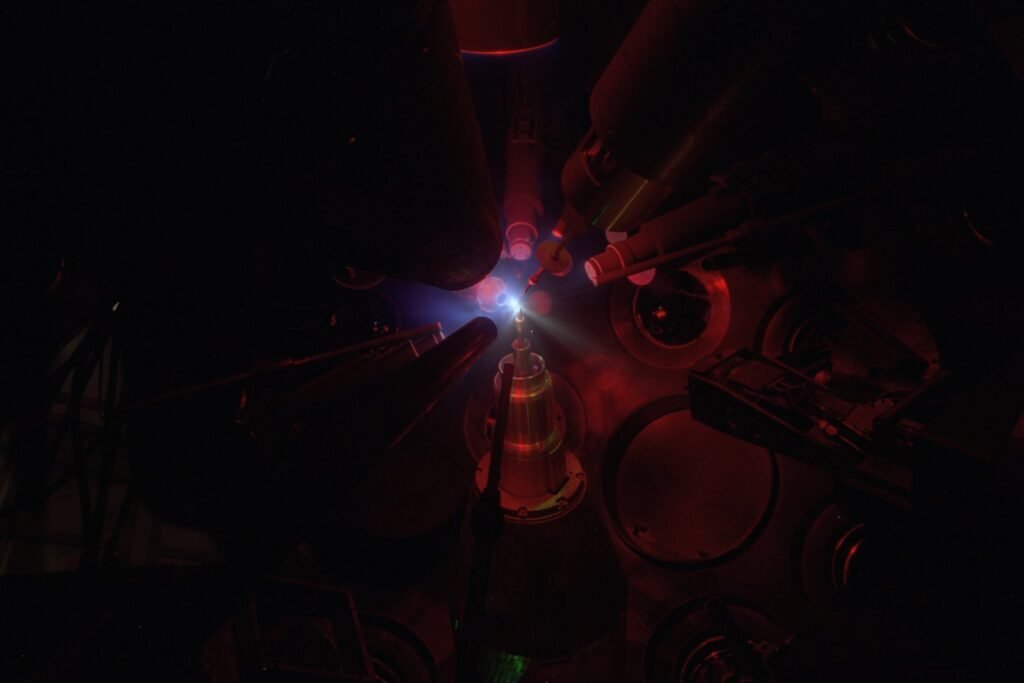
Researchers have extended the strong-field description of high-harmonic generation to include two-electron dynamics, opening a path to much higher photon energies than conventional single-active-electron models allow. In helium, the approach predicts a secondary plateau that reaches into the soft x-ray regime and approaches the keV scale.
Why the standard cutoff is no longer the whole story
High-harmonic generation (HHG) is a cornerstone of attosecond science and a leading route to coherent extreme-ultraviolet and soft x-ray light. In the familiar single-electron picture, the maximum photon energy is governed by the well-known cutoff scaling of 3.17 times the ponderomotive energy. That framework has been highly successful, but recent measurements in helium have hinted at a second, extended plateau that cannot be explained by one-electron motion alone.
This new work responds to that experimental signal by generalizing the strong-field approximation to account for processes involving two electrons. The result is a revised physical picture in which correlated dynamics can contribute to HHG well beyond the conventional cutoff.
A two-electron model with a higher cutoff
The authors analyze the generalized expressions using saddle-point methods and derive an extended cutoff for the emitted harmonics. Their theoretical scaling agrees well with classical estimates of roughly 4.7 and 5.5 times the ponderomotive energy, both markedly higher than the standard 3.17 factor. In practical terms, that means the available harmonic energy can rise substantially when two-electron pathways are active.
Using helium driven by an intense few-cycle infrared laser pulse, the team calculates spectra that stretch far beyond the water window, reaching approximately 1.2 keV. That places the emission solidly in the soft x-ray region and suggests that correlated electron dynamics can be harnessed as a useful source mechanism rather than treated as a minor correction.
What the spectrum implies for ultrafast sources
The broadened bandwidth is especially important for attosecond pulse synthesis. A continuum extending to higher photon energies can support sub-attosecond soft x-ray bursts, which are valuable for resolving electron motion on its natural timescale. Compared with lower-energy HHG sources, this regime offers stronger access to inner-shell transitions and element-specific contrast.
For photonics engineers and researchers, the result is notable not only because it revises the HHG cutoff, but because it points to a new design space for tabletop coherent x-ray generation. If two-electron effects can be controlled reliably, they may provide a route to brighter, harder harmonics without requiring a move to large-scale accelerator-based sources.
Potential applications and practical takeaways
The authors highlight several use cases that benefit from higher-energy coherent pulses and extremely short durations. These include core-level spectroscopy, ultrafast studies of matter, and imaging approaches that need both penetration and chemical sensitivity. The work also reinforces the importance of multi-electron physics in strong-field optics, especially when helium and similar systems are driven near the edge of high-intensity IR regimes.
- Two-electron dynamics can extend HHG cutoffs beyond the single-electron limit.
- Predicted cutoff scalings of 4.7 and 5.5 Up exceed the classic 3.17 Up benchmark.
- Calculated spectra reach about 1.2 keV, beyond the water window.
- The bandwidth could enable sub-attosecond soft x-ray pulse generation.
For the laser and photonics community, the main message is clear: correlated electron motion may be a powerful lever for pushing coherent light sources deeper into the soft x-ray domain.
Source: arXiv preprint: Two-Electron Effects Extend High-Harmonic Generation into the keV Regime