
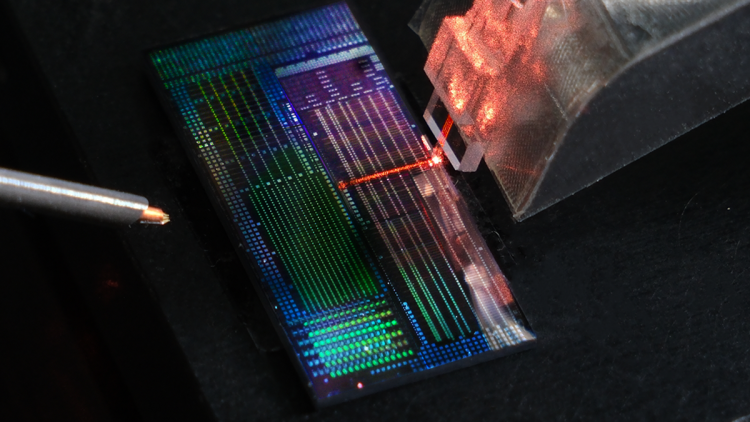
Quantum computing researchers at the University of Colorado Boulder have developed a revolutionary new device that could significantly accelerate the development of large-scale quantum computers. This breakthrough, published in Nature Communications, introduces an optical phase modulator that is nearly 100 times thinner than a human hair.
What makes this development particularly noteworthy is the manufacturing approach. Unlike previous quantum computing components that required custom-built laboratory equipment, this new device can be mass-produced using the same semiconductor fabrication processes used to manufacture microchips for smartphones, computers, and everyday electronics.
The technology addresses one of the key challenges in quantum computing: controlling the precise laser frequencies needed to manipulate qubits. Traditional approaches require large, table-top devices that consume significant amounts of power and generate substantial heat. The new chip-based solution uses roughly 80 times less microwave power than existing commercial modulators.
“You’re not going to build a quantum computer with 100,000 bulk electro-optic modulators sitting in a warehouse full of optical tables,” explained Professor Matt Eichenfield. “You need some much more scalable ways to manufacture them. If you can make them all fit on a few small microchips and produce 100 times less heat, you’re much more likely to make it work.”
The team is now developing fully integrated photonic circuits that combine frequency generation, filtering, and pulse shaping on a single chip. Next, they plan to collaborate with quantum computing companies to test these chips in advanced quantum computers.
This research was supported by the U.S. Department of Energy through the Quantum Systems Accelerator program.